Proposal
Lunch Sync PLATFORM for Lunch Decision
A Cloud-Native AWS Solution for Group Meal Decision-Making
1. Executive Summary
LunchSync is a real-time group decision-making platform designed specifically for office workers in high-density urban areas (e.g., District 1, Ho Chi Minh City). The project addresses the everyday problem of “what to eat for lunch” by digitizing the group negotiation process through gamified voting and a context-aware recommendation algorithm.
Unlike food delivery applications that focus on logistics, LunchSync does not sell food—it sells decisions, solving both preference conflicts and decision fatigue during lunch breaks. Built on a container-based serverless architecture (AWS Fargate), the system ensures high concurrency handling during peak hours, reducing decision time from 20 minutes to under 3 minutes, and optimizing users’ valuable lunch breaks.
2. Problem Statement
Current Problems
- Decision fatigue: After stressful work hours, users lack the mental energy to decide what to eat.
- Conflict of preferences: Groups with diverse tastes → difficulty reaching consensus.
- Resource wastage: Spending 15–20 minutes deciding → reduced break time and productivity.
- Low social friction: Group decisions avoid individual responsibility pressure, since the outcome is shared.
Solution
Core idea: A mobile-first application using real-time voting + elimination game mechanics to help groups finalize a restaurant in ~90 seconds.
How it works:
- Create a session quickly.
- Users select preferences via binary choices (10 food preference dimensions) instead of debating dishes.
- The system applies:
- Weighted Scoring → filter and rank restaurants.
- “Boom” (random elimination) → enforce final decision.
Users express preferences across 10 food dimensions: soup level, temperature, heaviness, flavor intensity, spiciness, texture, eating time, novelty, healthiness, and sharing style.
MVP Goals:
- Handle high concurrency (many users voting simultaneously).
- Process accurate geospatial data (group restaurants by area/landmark).
- Deliver a minimal UX focused on speed.
Technical Implementation:
- Architecture: Modular Monolith
- Design: Clean Architecture for maintainability and scalability
- Backend: ASP.NET
- Infrastructure: Fully deployed on AWS
MVP uses short polling (3-second interval) instead of WebSocket to reduce complexity. WebSocket will be considered in Phase 2.
Benefits & ROI
Security & Reliability: Private Subnet + Auto Scaling → high availability, minimal downtime
Performance: Flexible scaling during peak hours, low latency via CDN and caching
Development Focus: Managed services reduce operational overhead and accelerate MVP delivery
Cost:
- Core system: ~$78.42/month (~2,000,000 VND) for Fargate, RDS, ElastiCache (Multi-AZ)
- Infrastructure & Security (~$131/month):
- VPC Endpoints: $94.90
- ALB & Public IPs: ~$24.00
- Others (WAF, Logs, Route53): ~$12.00
ROI Summary (SaaS)
The following table assumes scaling after achieving product-market fit under a SaaS/Freemium model.
| Metric | Value |
|---|---|
| Initial Investment | $5,000 |
| AWS Cost / Month | ~$210 |
| Revenue (100 users) | $2,000 / month |
| Net Profit | ~$1,290 / month |
| Payback Period | ~3.9 months |
| ROI (1 year) | ~309% |
| Revenue (1,000 users) | $20,000 / month |
| AWS Cost (1,000 users) | ~$350 / month |
| Profit Margin | ~93% – 98% |
With ~$210/month, the system achieves High Availability (Multi-AZ) and automatic failover. If one Availability Zone fails, traffic shifts to another within seconds.
3. Solution Architecture
The system is built on Amazon Web Services (AWS) using a cloud-native architecture. Backend services run on Amazon ECS Fargate with a container-based serverless model, eliminating infrastructure management.
The application is deployed across multiple Availability Zones (Multi-AZ) with Auto Scaling to ensure high availability and scalability during peak hours. Traffic is distributed via an Application Load Balancer (ALB).
Frontend assets are hosted on Amazon S3 and delivered through CloudFront CDN to reduce latency. Security is enforced using AWS WAF, Amazon Cognito, and Security Groups.
Data is stored in Amazon RDS (PostgreSQL), while Amazon ElastiCache (Redis) handles caching and low-latency operations such as sessions and voting. Monitoring is handled by Amazon CloudWatch, and CI/CD is implemented via GitHub Actions, integrated with Amazon ECR and AWS IAM.
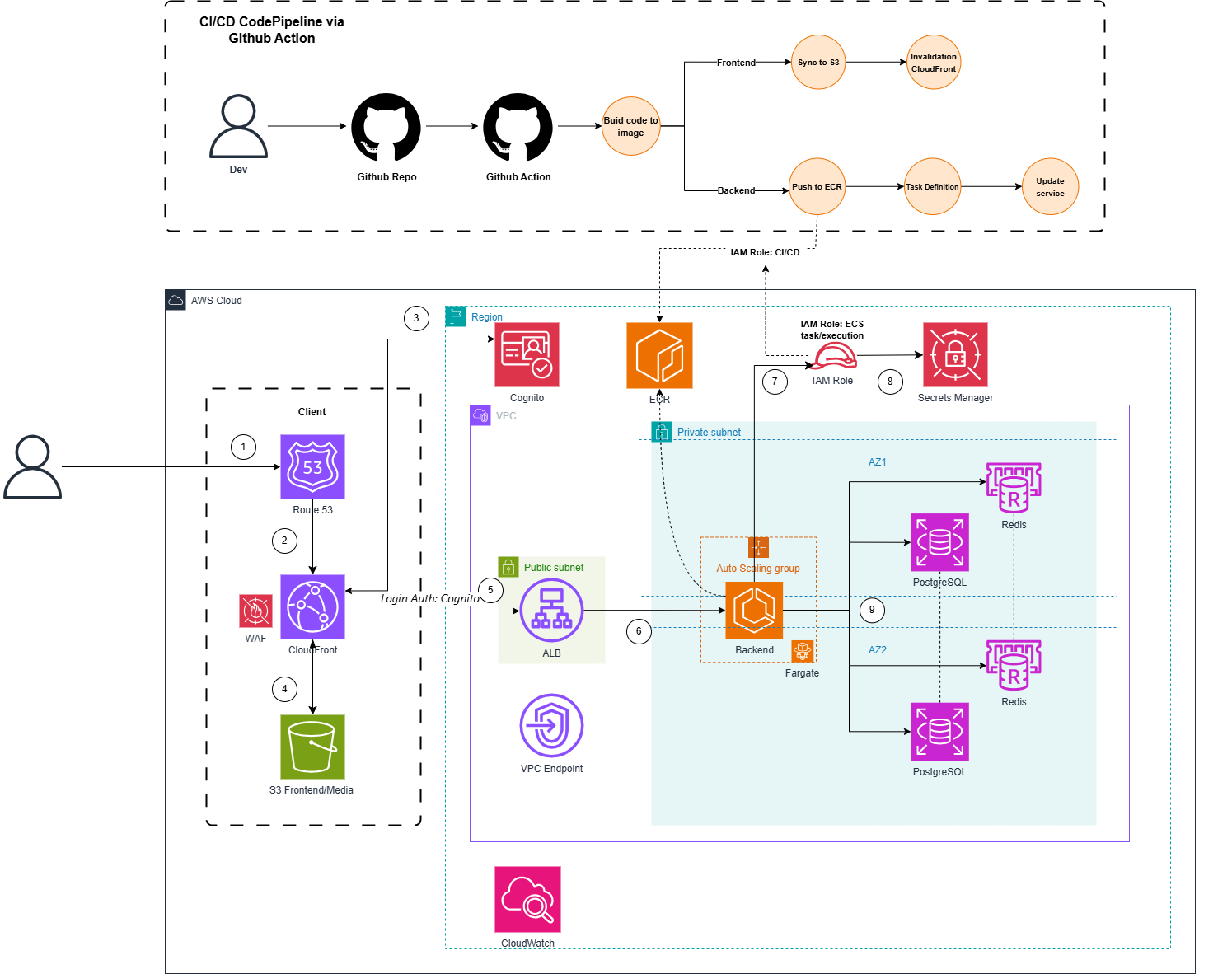
AWS Services Used
- Amazon ALB (Application Load Balancer): Distributes HTTP/HTTPS traffic
- Amazon ECS Fargate: Serverless container runtime for backend
- Amazon S3: Static asset storage and frontend hosting
- Amazon CloudFront: CDN for low-latency delivery
- Amazon Cognito: Authentication and authorization
- AWS WAF: Protection against common web attacks
- Amazon RDS (PostgreSQL): Relational database
- Amazon ElastiCache (Redis): Caching and real-time processing
- Amazon CloudWatch: Monitoring (logs, metrics, alarms)
- Amazon ECR: Container image registry
- AWS IAM: Access control management
- AWS Secrets Manager: Secure credential storage
- VPC Endpoint: Secure connectivity between private subnet and AWS services
4. MVP Scope
| Aspect | In Scope | Out of Scope |
|---|---|---|
| Meal type | Lunch only | Dinner, breakfast, café |
| Platform | React Web App (mobile-first) | Native mobile app |
| Backend | ASP.NET Pragmatic Modular Monolith | Microservices |
| Database | PostgreSQL | NoSQL |
| Vector computation | In .NET (basic math) | Python external service |
| Group size | 3–8 users | >8 |
| Auth | Host account (JWT - Cognito), participants via nickname | Social login (optional) |
| Data | Manual curation | Auto-crawling |
| Geography | Single area (3–5 collections) | Multi-city |
| Monetization | Free | Paid plans |
| Dietary | Not included | Vegan, allergy, halal |
| Restaurant action | Google Maps link | Booking, reviews, ordering |
5. Tech Stack
| Layer | Technology | Hosting |
|---|---|---|
| Frontend | React + TypeScript + Vite + Tailwind CSS | S3 + CloudFront |
| Backend | ASP.NET Web API + EF Core | ECS Fargate |
| Database | PostgreSQL 15+ | AWS RDS (db.t3.micro Free Tier) |
| Media Storage | — | AWS S3 |
| Auth (Phase 1) | Simple JWT | Amazon Cognito |
| CI/CD | GitHub Actions | Build + Deploy |
| Version Control | Git — GitHub | — |
6. Key Features
Group Voting Lunch Restaurant Flow
PHASE 0: SETUP (Host)
- Create group session (3–8 users)
- Set budget cap (e.g., 50,000 VND/person)
- Select landmark-based collection
PHASE 1: INDIVIDUAL BINARY CHOICE
- Each user answers 7–12 binary questions
- Generates a preference vector per user
PHASE 2: AGGREGATE & SUGGEST
- Merge vectors into a session-level vector
- Score all dishes → select top 10
- Filter dishes available in the selected collection
- Suggest top 3 dishes
PHASE 3: RESTAURANT MATCHING
- Rank restaurants based on collection + budget
- Suggest top 5 restaurants
PHASE 4: GROUP PICK
- Group vetoes 2 → finalize 1 restaurant
- Decision via voting or host
7. Roadmap & Milestones
Internship (Months 1–3):
- Month 1: Learn AWS and core services
- Month 2: Design and refine architecture
- Month 3: Implementation, testing, deployment
Post-deployment:
- Continue research and improvements over 1 year
8. Budget Estimation
Full System Cost (2 AZ – 30 Days)
| Service Group | Component | Calculation | Cost (USD/Month) |
|---|---|---|---|
| VPC Endpoint | 5 Interface Endpoints | 5 × 2 AZ × 730h × $0.013 | $94.90 |
| Load Balancer | ALB + 2 Public IPs | ($0.0225 + $0.01) × 730h | $23.72 |
| Compute | ECS Fargate | 2 tasks (0.25 vCPU - 0.5GB) | $19.00 |
| Database | RDS PostgreSQL | t3.micro (Multi-AZ + 20GB) | $30–34 |
| Cache | ElastiCache Redis | t3.micro (Multi-AZ) | $24–26 |
| Monitoring | CloudWatch + WAF + Secrets | Low usage | $10.50 |
| Others | Route53, S3, ECR, Cognito | Maintenance | $2.00 |
| TOTAL | ~$204–$210 |
Evaluation
- Fault Tolerance: Extremely high. The system can withstand a full AZ failure without service disruption.
- Security: Highly optimized (private subnet, no public IP, traffic via PrivateLink).
- Cost: ~5.2 million VND/month
9. Risk Assessment
| Risk | Level | Mitigation Strategy | Contingency Plan |
|---|---|---|---|
| Infrastructure / Uptime (AZ failure) | Low | Multi-AZ + ALB failover | Not required (handled by AWS) |
| Security (DDoS, SQLi) | Low | WAF + Cognito + Private Subnet | Rotate credentials, isolate system |
| Deployment bugs | Medium | CI/CD + automated testing | Rollback (ECS task revision) |
| Cost overrun | High 🔴 | Auto Scaling limits, WAF rate limit | AWS Budgets + billing alerts |
| Performance at scale | Medium | Redis cache, CDN | Scale DB / add read replicas |
10. Expected Outcomes
- Infrastructure: Cloud-native architecture (Multi-AZ, Auto Scaling) ensures high availability, scalability, and reduced downtime risk
- Operational Efficiency: Managed services reduce DevOps workload and accelerate development
- Financial Efficiency: Low cost with high profit margins, enabling scalable growth
Build a stable, scalable SaaS platform with strong long-term growth potential and cost efficiency.